The History of Digital Photography and Image Compression
Learn how CCD sensors, early digital cameras, memory cards, JPEG compression, and smartphones transformed photography.
Introduction
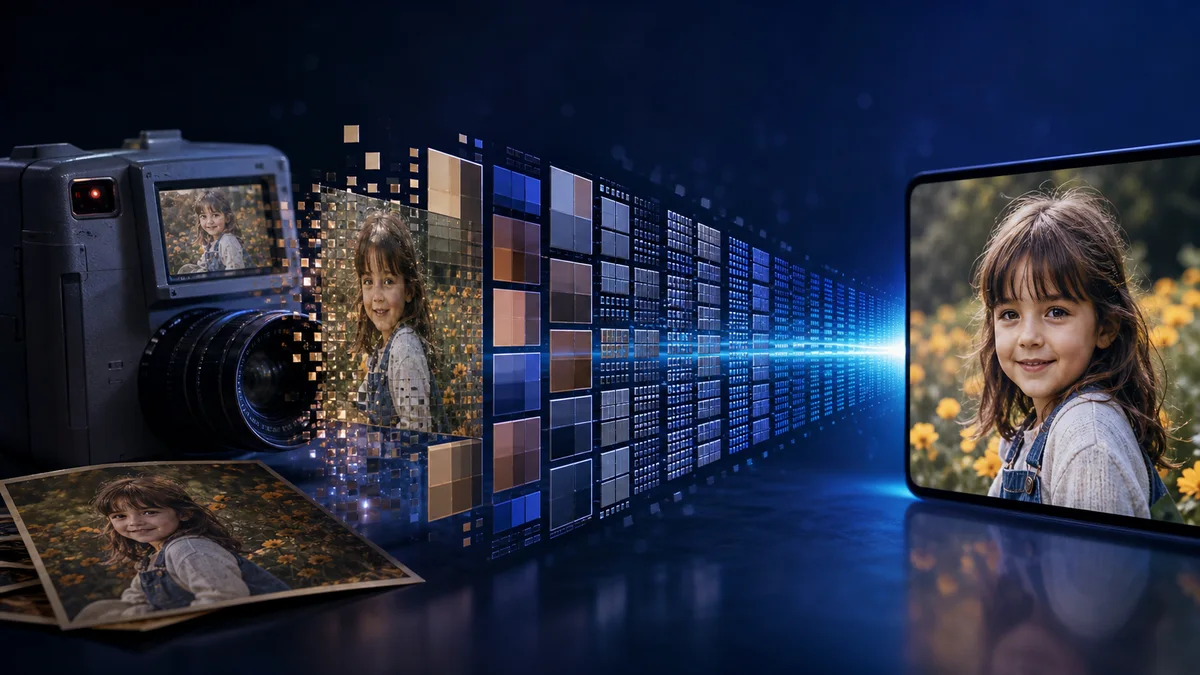
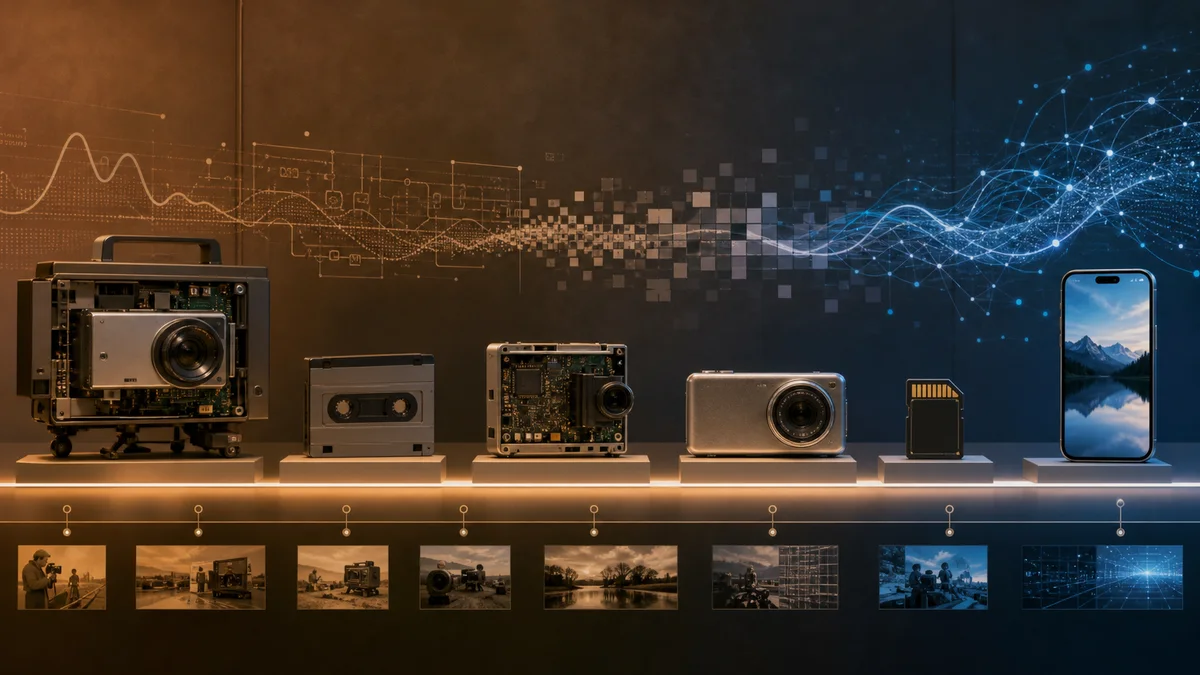
Digital photography required more than replacing film with a sensor. Engineers needed a way to convert light into electrical measurements, store millions of values economically, process color, compress files, display the result, and move it between devices. Progress in sensors, semiconductor memory, batteries, processors, standards, and networks had to converge.
Compression was essential to that convergence. An uncompressed color photograph can consume many megabytes even at modest dimensions. Early storage media and communication links could not support casual shooting at that scale. JPEG made photographic files manageable, while later raw formats preserved sensor information for editing and newer codecs improved delivery efficiency. The history of the camera is therefore also a history of data.
From electronic sensors to a prototype camera
Willard Boyle and George E. Smith developed the charge-coupled device at Bell Labs in 1969. CCD technology could transfer accumulated electrical charge across a chip, and image sensors based on the idea became important in astronomy, video, and photography. CMOS sensor development later provided another path with advantages in integration and power.
At Kodak in 1975, engineer Steven Sasson built a portable digital-camera prototype using a CCD sensor. The device captured a black-and-white image of roughly 0.01 megapixel and recorded the data to a cassette. Playback required separate equipment and took time. It was not a consumer product, but it demonstrated an end-to-end electronic still-photography system.
Commercial cameras and standards
Electronic still-video cameras appeared in the 1980s, often storing analog video frames rather than fully digital files. Professional digital camera systems arrived around the turn of the 1990s, followed by increasingly practical consumer models. Memory cards, LCD previews, USB, and improving batteries removed friction year by year.
JPEG standardization in 1992 gave cameras a widely understood compressed output. EXIF metadata helped store camera settings, capture time, orientation, and thumbnails. Manufacturers also developed raw formats that retained more direct sensor data for later demosaicing, white-balance adjustment, and tonal recovery.
What a digital camera actually records
Most sensors measure one color component at each photosite through a color-filter array. A demosaicing algorithm estimates full-color pixels from neighboring measurements. The camera then applies white balance, tone curves, noise reduction, sharpening, and color rendering. A JPEG is already an interpreted image, not a neutral dump of the sensor.
A raw file preserves more measurement and processing flexibility, although it is still governed by the sensor and camera design. It is larger and requires compatible software. The JPEG is smaller and ready to share but offers less latitude for major exposure or white-balance changes.
Real-world examples
A 1990s newspaper photographer could review images without processing film and transmit selected JPEGs electronically. A family could fit hundreds of compressed photographs on a memory card instead of buying and developing rolls. A wildlife photographer could shoot long bursts because cameras buffered and compressed data efficiently.
Today, a smartphone may capture several frames, align them, choose sharp regions, reduce noise, and combine exposures before saving one HEIC or JPEG. A professional may simultaneously record raw plus JPEG: the JPEG supports quick delivery, while raw provides room for careful color and highlight recovery.
Advantages
- Immediate review reduces uncertainty and material waste.
- Metadata records useful capture and workflow information.
- Compression allows many photographs to fit on portable storage.
- Digital copies can be transmitted, backed up, searched, and duplicated without analog generation loss.
- Raw capture provides extensive adjustment latitude.
- Computational photography can overcome some limits of small lenses and sensors.
Disadvantages and tradeoffs
- Digital archives depend on storage integrity, backups, formats, and readable software.
- JPEG compression can discard detail and accumulate artifacts after repeated saves.
- Raw formats require processing and may be proprietary or version-dependent.
- Location and device metadata can expose private information.
- Computational processing may produce an attractive but less documentary result.
- The ease of taking thousands of pictures can create an organization and selection burden.
Building a durable photo workflow
Preserve original camera files and maintain more than one backup, preferably with one copy in a different physical location. Organize by date and event, add descriptive metadata, and periodically verify that files can be read. Do not use a social-media download as the only archive; platforms resize and recompress uploads.
The importance of color management
Digital files also need an agreed interpretation of color. A display, browser, printer, and editing application may render the same numerical values differently unless profiles and calibrated workflows connect them. For ordinary web delivery, sRGB remains a practical compatibility choice. Photographers can keep a wider-gamut master while exporting a converted, embedded-profile copy for the web. Ignoring this step may produce muted color or unexpected skin tones even when compression settings are technically sound.
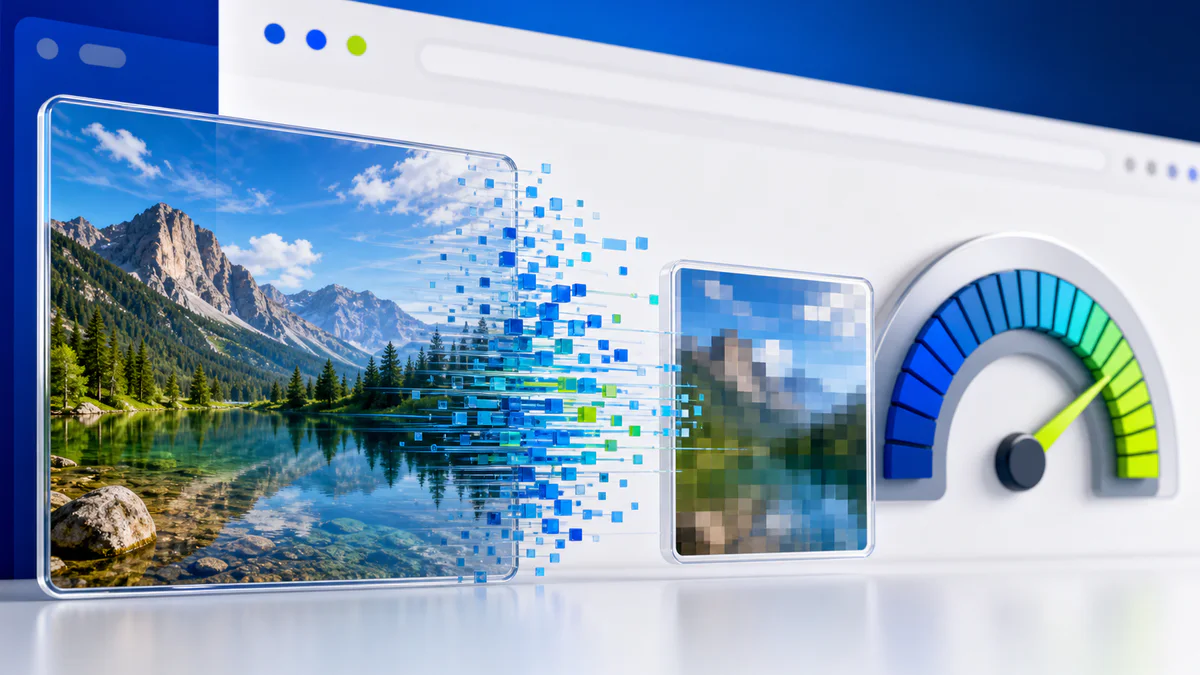
Create delivery copies for each purpose. A website photograph may become a correctly sized WebP or JPEG; a transparent graphic may be PNG. Use Compress Image after resizing, not as a substitute for resizing. Strip location metadata from public copies when privacy matters while keeping useful archival metadata in protected originals.
Frequently asked questions
What was the first digital camera?
The answer depends on definitions, but Steven Sasson's 1975 Kodak prototype is widely cited as the first self-contained digital still camera. It was experimental and not sold to consumers.
Why was JPEG important to digital cameras?
It dramatically reduced photographic file sizes and provided a common standard, allowing practical storage and exchange across cameras and computers.
Is raw always better than JPEG?
Raw offers more editing latitude, but it requires processing and storage. JPEG can be the better operational choice when speed, compatibility, and a finished in-camera look matter.
Can digital photographs last forever?
Perfect copying is possible, but storage media and file access fail. Long life requires multiple backups, integrity checks, sensible formats, and occasional migration.
Conclusion
Digital photography became practical through a system of inventions rather than one camera: electronic sensors captured light, processors interpreted it, compression reduced it, storage held it, and networks moved it. The best modern workflow respects both sides of that history—preserve rich originals for the future and create efficient, purpose-built copies for today's screens.
Sources and further reading
National Inventors Hall of Fame — Steven Sasson
Nobel Prize — Boyle and Smith's imaging semiconductor circuit