The First Image Editors: From SuperPaint to MacPaint
Explore the early systems that introduced pixel painting, frame buffers, menus, tools, and the visual ideas behind today's image editors.
Introduction
Asking for the “first image editor” sounds simple until the terms are defined. Researchers manipulated digital pictures before personal computers existed. Some systems processed scanned images numerically, others let users draw vectors, and still others provided interactive painting on a raster display. Modern editors combine all of these traditions, so no single program invented every concept.
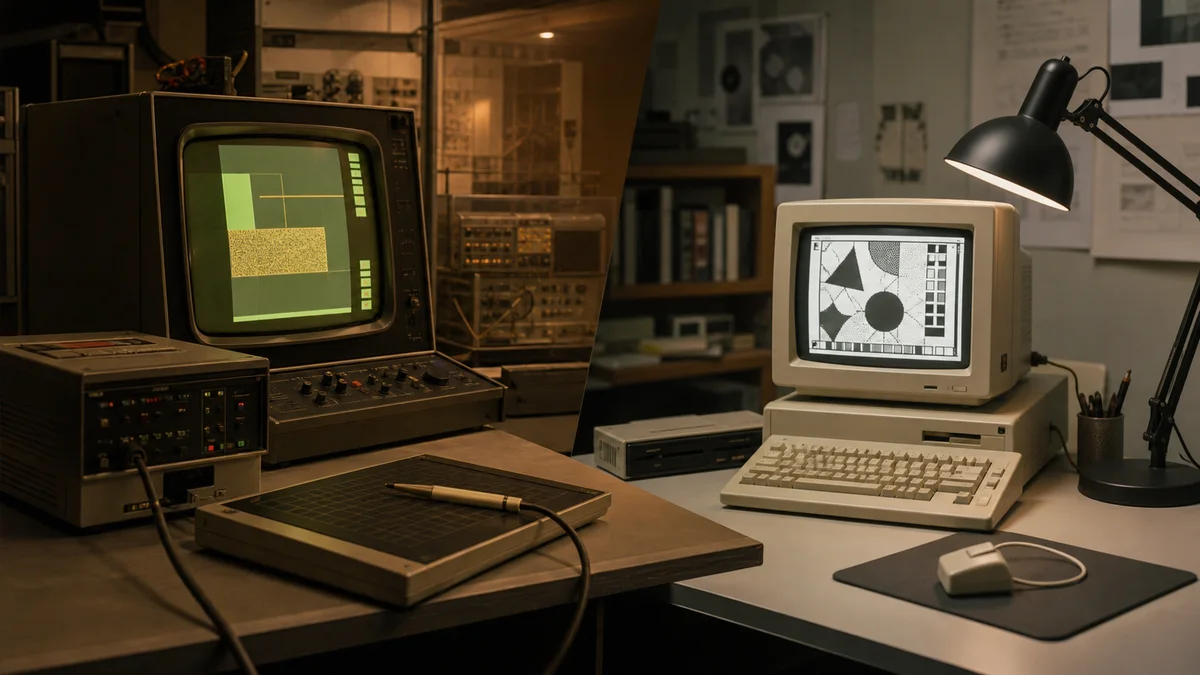
SuperPaint, developed by Richard Shoup at Xerox PARC in the early 1970s, is widely recognized as a pioneering complete digital paint system. It joined a frame buffer, color display, video input and output, and interactive software. A decade later, MacPaint brought approachable mouse-driven bitmap editing to a mass personal-computer audience. Between them lies the transition from rare laboratory hardware to visual software ordinary people could use.
Before interactive paint programs
Early computer graphics were often vector-based: a display drew lines between coordinates rather than storing a color value for every screen pixel. Ivan Sutherland's Sketchpad, demonstrated in 1963, established influential interactive drawing and constraint ideas, but it was not a photographic raster editor in the modern sense.
Raster work required memory for a frame buffer. At a time when memory was extremely expensive, storing a complete screen of pixels was a major engineering commitment. Scanners, television signals, and scientific imaging systems could digitize pictures, but immediate brush-like interaction depended on both specialized hardware and responsive software.
SuperPaint at Xerox PARC
Richard Shoup began SuperPaint at Xerox PARC in 1972. The system used a custom frame buffer capable of storing and displaying color pixels. Users could paint with a tablet, select colors, create shapes, manipulate regions, and combine live video with computer graphics. It supported work that now feels familiar—pixel editing, palettes, and image compositing—on hardware far beyond the reach of consumers.
Artist and computer scientist Alvy Ray Smith joined the work and used SuperPaint to explore digital art and animation. The system later received technical recognition for its influence on television graphics. Its significance is not that it resembled a current laptop editor screen for screen; it proved that interactive raster painting could be a creative medium and production tool.
MacPaint and personal computing
Apple released the Macintosh in 1984 with MacPaint, created primarily by Bill Atkinson. The monochrome program used a mouse, windows, menus, patterned fills, selection tools, brushes, text, and the clipboard. It worked closely with MacWrite, demonstrating that graphics and words could move between consumer applications.
MacPaint had no color, layers, AI selection, or nondestructive filters. Its achievement was accessibility. The tool palette and direct manipulation made bitmap editing legible to people who were not graphics researchers. Susan Kare's icon and interface work also helped establish a visual vocabulary that made unfamiliar computer actions approachable.
Real-world examples
SuperPaint could combine video imagery with painted graphics for research and broadcast experiments. That foreshadowed compositing systems used in television and motion design. MacPaint users could draw an illustration, select it, copy it into a document, and print the page on a graphical printer—a routine workflow now, but a striking integration in 1984.
Today's background remover inherits the selection tradition, even when a model predicts the mask. A layers panel formalizes the compositing that early systems achieved with more limited buffers. The history shows that modern “magic” tools still depend on recurring ideas: represent pixels, identify regions, transform them, and preserve enough state to revise the result.
Advantages of the early systems
- They made visual interaction immediate instead of relying only on numerical commands.
- Frame buffers established the pixel-addressable canvas used by raster editors.
- Tool palettes, selections, fills, and clipboard operations created durable interface conventions.
- Video input and compositing connected computer imagery with broadcast production.
- MacPaint demonstrated that graphics software could serve general personal-computer users.
- Their limitations encouraged efficient icons, patterns, and algorithms.
Disadvantages and constraints
- SuperPaint required rare, costly custom hardware and laboratory access.
- Early memory and processing limits restricted resolution, color depth, and undo history.
- MacPaint was monochrome and flattened work into a small bitmap canvas.
- File exchange and color management were primitive compared with modern standards.
- Editing was destructive; users could not revisit a long stack of adjustable effects.
- Surviving demonstrations can make experimental systems appear more complete than everyday use actually was.
What modern creators can learn
The best early tools made their limited operations understandable. A brush behaved like a brush, a selection visibly bounded an area, and a clipboard connected applications. Modern products gain power when AI remains similarly legible: users should know what changed, keep the original, and be able to undo or refine the result.
Constraints also sharpen decisions. MacPaint artists produced recognizable work with one-bit color because composition and silhouette mattered more than effects. A modern creator can apply the same lesson by beginning with a clear subject and hierarchy before adding filters or enhancement. Use Pixores Crop Image to strengthen framing and Resize Image only after the composition is settled.
Frequently asked questions
Was SuperPaint the first image editor?
It is often described as the first complete digital paint system, but “first” depends on whether one includes earlier scientific image processing, vector drawing, or experimental displays. It is safest to call it a foundational interactive raster paint system.
Was SuperPaint related to the later Windows program with the same name?
No. Several products have used similar names. The historically important SuperPaint discussed here was Richard Shoup's early-1970s Xerox PARC system.
Why was MacPaint important if it was black and white?
It put mouse-driven bitmap editing, familiar tools, clipboard exchange, and graphical printing into a consumer product. Accessibility and integration mattered as much as color depth.
Did early editors have layers?
Not in the modern persistent, reorderable sense familiar from professional editors. Compositing existed, but editable layer stacks developed through later graphics systems and applications.
Conclusion
Digital image editing did not begin with one application or one brilliant moment. It grew from interactive drawing, frame-buffer engineering, video experimentation, interface design, and personal computing. SuperPaint demonstrated a rich pixel-painting system; MacPaint made core ideas approachable at home and work. Modern AI tools extend that lineage, but clarity, control, and reversible decisions remain the qualities that make an editor genuinely useful.
Sources and further reading
Computer History Museum — SuperPaint